
The History of Run Island, Maluku Indonesia
Indonesia · Banda Sea
The History of Run Island, Maluku Indonesia
Approaching the Banda Islands is one of those rare arrivals nobody forgets. Behind the smoking cone of Gunung Api, eleven small islands trace the trade that built — and destroyed — half of the early modern world. The story of nutmeg, of a 3 km island swapped for Manhattan, and of what is left to see today.
Scroll · 1500 → today
An eight-chapter timeline
A 3 km island that was once worth Manhattan.
Run is the westernmost of the Banda Islands — three kilometres long, one kilometre wide. About two thousand people live here today. For thirty years in the 17th century, every European empire wanted to own it; at one point, Britain held it as its first overseas colony, defended for 1,540 days against Dutch siege. Then they traded it for Manhattan. Here is how it happened, and what visiting these islands looks like today by private yacht charter in Indonesia.

Chapter 01 · The archipelago
Eleven islands, eight thousand years of trade
The Banda Islands are eleven small volcanic outcrops in the Maluku Sea, rising from water four to six kilometres deep. The first known human presence dates back 8,000 years; Chinese records mention the archipelago from 200 BCE. Long before any European arrived, the Bandanese were shipping the only nutmeg in the world to Java, Malacca and India — an oligarchy of orang kaya (‘rich men’) ran the trade.
The largest island is Banda Besar, the administrative centre Banda Neira, the volcano Gunung Api. And on the western edge, three kilometres long and barely a kilometre wide, sits Run.

Chapter 02 · The spice that changed the world
Second only to gold
Nutmeg was worth its weight in silver. Used as a meat preservative, a medicine — including, it was believed, against the bubonic plague — and a luxury flavouring, it was the kind of commodity Europe organised wars and treaties around. And it grew, almost exclusively, on Banda.
A single average-quality cloth could be traded locally for 18 kilograms of nutmeg; the same kilo sold for 300 times its purchase price by the time it reached Amsterdam. That mathematical fact — a 30,000% markup — explains the next two hundred years of Banda’s history.

Chapter 03 · The Dutch arrive
The VOC makes Banda its base
Dutch traders had been calling at Banda since 1599. By 1602, competition between them was eating into profits, so they pooled their fleets into the Dutch East India Company (VOC) — the world’s first multinational corporation, with its own armies, its own coins, and the legal right to wage war.
In 1609 the VOC tried to build Fort Nassau on Banda Neira. The Bandanese ambushed Admiral Verhoeff and 46 of his men and beheaded them. Among the survivors was a young merchant named Jan Pieterszoon Coen, who would remember.

Chapter 04 · Britain’s first overseas colony
1,540 days under siege
While the Dutch built forts, the English had been quietly negotiating with the islanders. On 25 December 1616, Captain Nathaniel Courthope landed on Run with the Swan and the Defence. A treaty was signed with the local leaders, accepting James I as sovereign of the island — Run thus became, in the strict legal sense, the first overseas colony of the British Empire.
Courthope and 39 men, with the islanders, held off a continuous Dutch siege for 1,540 days. He was shot dead in 1620 while rowing at night to a nearby island. The British withdrew.

Chapter 05 · The Banda genocide
15,000 islanders, 1,000 survivors
Newly appointed VOC governor-general Jan Pieterszoon Coen landed on Banda Neira in 1621 with a small army. The orang kaya were forced at gunpoint to sign an impossible treaty, then accused of breaking it. Forty leaders were beheaded by Japanese mercenaries in Coen’s service, their heads displayed on bamboo spears.
Within months, an island population of 13,000 to 15,000 was reduced to about 1,000. Survivors were enslaved on their own plantations. On Run, the Dutch went further: every nutmeg tree was cut down to prevent the British from ever benefiting. Cattle were left to roam.

Chapter 06 · The Treaty of Breda
Run swapped for Manhattan
The Second Anglo-Dutch War ended at Breda in 1667 with a status quo agreement: each empire kept what it had taken. The British kept the island of Manhattan, seized by the Duke of York three years earlier — renaming New Amsterdam to New York. In return, England formally surrendered any claim to Run.
Every contemporary observer agreed the Dutch had got the better deal. As the BBC put it, the tiny island the British traded for Manhattan was, in 1667, by far the more valuable of the two.

Chapter 07 · The end of the monopoly
The trees that left Banda
During the Napoleonic Wars the British briefly retook Banda — Captain Christopher Cole stormed Fort Belgica in a single morning in 1810. Before handing the islands back at the end of the war, the British uprooted hundreds of nutmeg saplings and shipped them to Ceylon, Grenada, Penang and Singapore.
Within a decade the Dutch monopoly was broken. Within a generation, Banda was forgotten. The empire that had built itself on Run’s spices simply walked away — and the islands slipped out of every map that mattered.
Chapter 08 · Run today
3 km long, 2,000 people, one generator
Run today has about 2,000 inhabitants, mostly descendants of plantation workers brought from elsewhere in Indonesia. There is one medical clinic with no resident doctor. Electricity runs from 6pm to 11:30pm on a generator donated by a businessman from Jakarta. Water is collected from rain in shared cisterns.
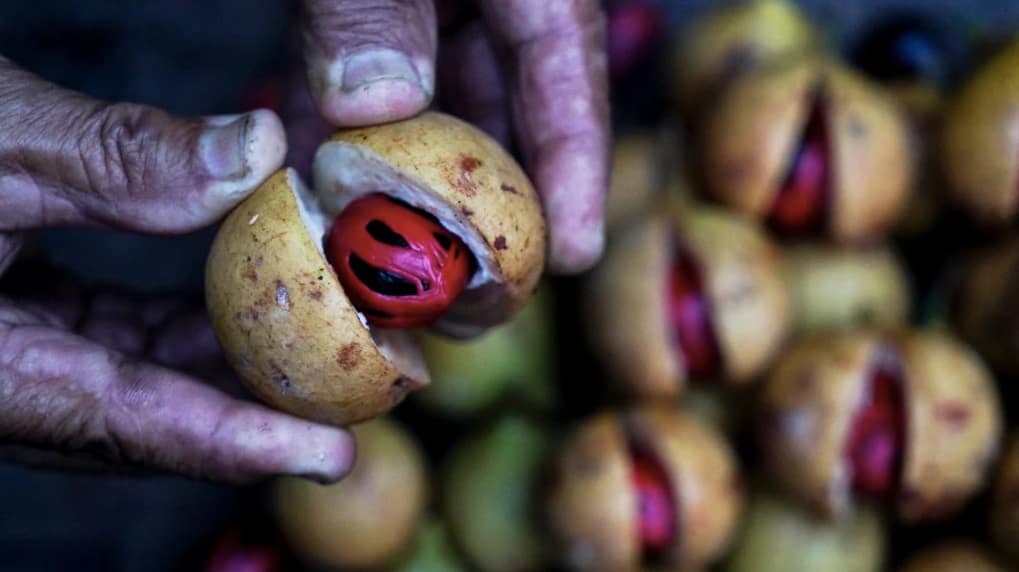
Nutmeg is still grown — the trees that escaped Coen’s axe in 1621 — and still pounded into oil by hand. The wooden phinisi schooners that anchor offshore look not so different from the East Indiamen that besieged the island in 1620.

Banda Islands · Today
Why visit Run, Ai and Hatta
The diving here is among the most pristine in Indonesia. Walls drop straight into 4 km of blue water; reef fish, mandarinfish, hammerheads. The local people are welcoming, the food simple, the sunsets long. There are no big resorts — there is no big anything.
For travellers fascinated by history, by remote islands or by underwater life, a charter through the Banda Sea on a phinisi schooner is one of the most rewarding journeys in Southeast Asia.
Plan your charter
Sail the Banda Sea by phinisi
Tell our brokers your dates and group size — we will suggest the right liveaboard yacht to anchor off Run, dive the walls of Ai and Hatta, and watch Gunung Api turn red at sunset.

Want to explore the Banda islands in 2026 or 2027, Oct/Nov. 3-4 weeks. Can you offer some options?
Hello Dean, Sure we can organise a beautiful trip for you